Wave Forms for La Favre marimba - different modes of vibration
|
The wave form below is the C2 bar struck
with the soft mallet in the center of the bar. The time slice for
this graphic ranges from 0.15 second to 0.31 second. Two modes of
vibration are clearly visible. The waves that have a small width
are the third transverse mode, tuned to the 10th harmonic. Notice
that these waves also go up and down in a pattern that repeats every
10 waves. These are the fundamental waves. The 10th harmonic waves
are strong (have a relatively large distance between the top and
bottom of the wave) at 0.15 second but diminish substantially by
time 0.31 second. From this view, it is apparent that the 10th harmonic
contributes significantly to the timbre of the bar early in its vibration
history. Later, the timbre is heavily influenced by the fundamental
mode of vibration.
Click
to hear C2 with soft mallet
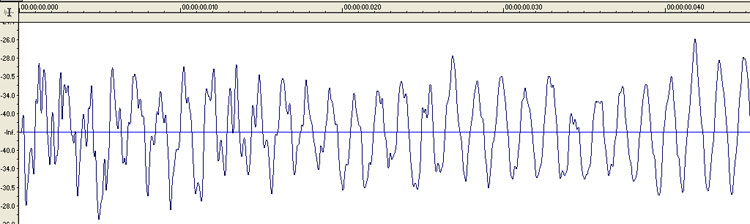
The wave trace below is the C2 bar struck with
the soft mallet in the center of the bar. The time span is 0.000
to 0.045 second. When a bar is struck with a mallet, there is
an initial transient state of disorganized vibrations that give rise
to the mallet impact sound. These occur within the first few milliseconds
of mallet impact. The first 0.025 second of vibration in this bar
is marked by some vibrations, seen as double peaks of the waves
for the 10th harmonic. These are vibrations of the fourth transverse
mode which reside near the 20th harmonic, but are not tuned in this
bar. A soft mallet striking
the center of the bar is not the correct condition for exciting the
fourth transverse mode, so it appears very weak here.
The wave form below is the E2 bar struck with the medium mallet
in the center of the bar. The waves of the tenth harmonic are clearly
visible and they undulate with a pattern matching the frequency of
the fundamental.
Click
to hear E2 with medium mallet (struck at bar center)
The wave form below is the E2 bar struck with the medium mallet near
the antinode of the second transverse mode. Here we see a dramatically
different wave pattern due to the strong excitation of the second
transverse mode. This wave trace brings
home the importance of tuning the second transverse mode to the fourth
harmonic. Some performers prefer to strike the
bar off center to yield the sweeter sound of the fundamental and
second transverse mode. In any case, both the second and third transverse
modes should be tuned in bass bars. Listen to the difference in this
bar depending on the location of the mallet blow (the audio link
above compared to the audio link below).
Click
to hear E2 with medium mallet (struck near antinode of second transverse
mode)
The wave trace below is the C3 bar struck with the soft mallet in
the center of the bar. The time span is 0.000 to 0.090 second. The
10th harmonic is visible in the left half of the trace and damps out
mostly at 0.043 second. The initial transient state of vibration is
also apparent in this trace, ending at about 0.007 second.
Click
to hear C3 with soft mallet
The wave trace below is the C3 bar struck
with the medium mallet in the center of the bar. The time span is
0.207 to 0.296 second. The 10th harmonic is visible in the left
half of the trace and damps out mostly at 0.265 second. Comparing
the traces for the C3 bar struck with soft and medium mallets, it
is clear that the medium mallet excites the third transverse mode
to a greater degree than the soft mallet. These results confirm what
is already known by players of the instrument: harder mallets bring
out the overtones in the bar.
Click
to hear C3 with medium mallet
The wave trace below is the A3 bar struck with the medium mallet in
the center of the bar. The time span is 0.022 to 0.067 second. Here
the 10th harmonic damps out around 0.045 second. Compare this damping
time with that for the C3 bar, where the 10th harmonic damps out at
0.265 seconds. The 10th harmonic is not as influential on the timbre
of the A3 bar as it is on the C3 bar. Further below you will note that
the 10th harmonic is not seen at all in the C4 bar struck with the medium
mallet. Therefore, the 10th harmonic ceases to be of importance somewhere
in the zone of A3 to C4. Tuning of the 10th harmonic is known in some
marimbas to end around C4, which seems logical in light of the results
reported here.
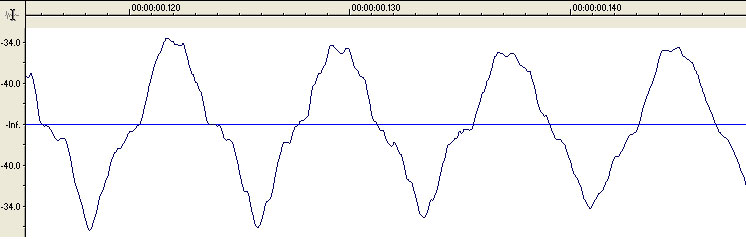
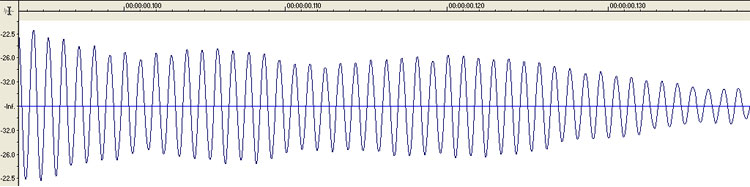
The wave trace below is a highly magnified view of the C3 bar struck
with a soft mallet in the center of the bar. The fundamental mode of
vibration is very dominate here. Unlike the C2 bar, the C3 bar displays
almost no 10th harmonic during the time span of 0.116 to 0.147 second.
Careful examination reveals the 4th harmonic, which is seen as humps
on the wave form of the fundamental. The fourth harmonic is stronger
in the C4 bar, which is illustrated next below. These results also show
the importance of the type of mallet used to excite the bar. With a
medium mallet the 10th harmonic is clearly present at the time period
of 0.120 seconds while it is nearly absent with the soft mallet.
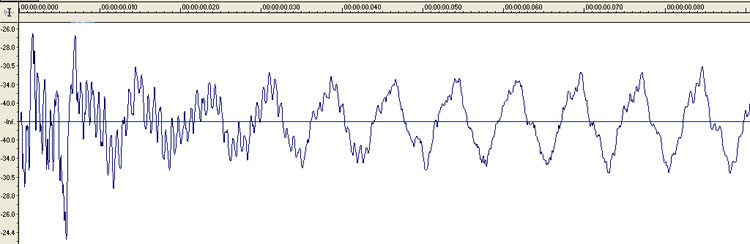
The wave form in the next two graphics below is the C4 bar struck with
the medium mallet at the center of the bar. The first graphic covers
the time period 0.00 to 0.045 second and the second graphic covers the
time period 0.045 to 0.089 second. From 0.000 to 0.007 second (0 to
7 milliseconds), there is no obvious mode(s) of vibration. This is the
initial transient state of vibration where the impact sound of the mallet
is heard. Starting at 0.007 second, the fourth harmonic mode is clearly
seen. Note that the peaks of the 4th harmonic waves have a repeating
pattern every four waves, which is the fundamental. The 4th harmonic
is nearly gone by time 0.070 second and at this point the fundamental
is very obvious. Note that the waves of the 10th harmonic can't be seen
in this trace. Therefore, the timbre of this bar during the first 70
milliseconds is influenced by the fundamental and 4th harmonic modes
of vibration. Beyond 70 milliseconds, the timbre is due almost entirely
to the fundamental.
Click
to hear C4 with medium mallet
The wave form below is the C5 bar struck with the medium mallet at
the center of the bar. The time span covers 0 to 33 milliseconds. The
4th harmonic mode appears briefly but disappears at 25 milliseconds.
At that time, the pure sine wave pattern of the fundamental is apparent.
Click
to hear C5 with medium mallet
The wave form below is the C6 bar struck
with the hard mallet at the center of the bar. The time span covers
94 to 138 milliseconds. The fundamental mode is the only mode that
is obvious in this trace. However, there is a pattern of higher and
lower wave amplitudes which indicates the presence of another mode
of vibration that has a frequency close to the fundamental or a multiple
of it. In other words, there is a weak beating pattern of
two close frequecies.
Click
to hear C6 with hard mallet
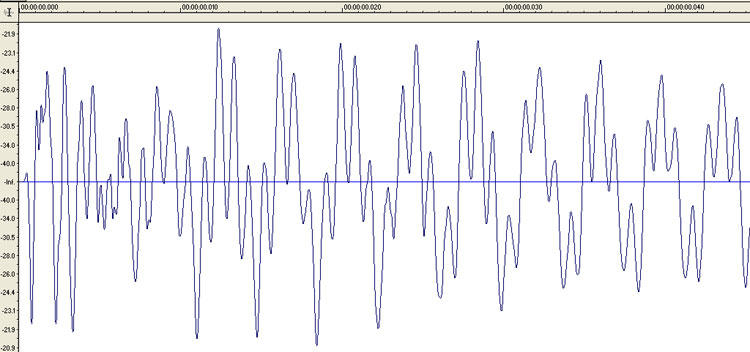
The wave form below is the C6 bar struck with the hard mallet at the
center of the bar. The time span covers 0 to 45 milliseconds. The wave
pattern is remarkable in that the fundamental waves appear immediately
in nearly pure sine wave form. There is no initial transient period
of irregular vibrations. A marked pattern of amplitude changes over
time is also seen in this wave trace. This behavior is also seen in
the bars between C5 and C6, but to a lesser degree. The cause of these
fluctuations in amplitude are due to the presence of a beating frequency
of another mode (another mode with a vibration rate near that of the
fundamental or multiple of it).
I must first caution that the wave analyses here are derived from one
instrument. In the ideal situation, it would be better to have data
for several instruments, made by different builders, with bars of the
various woods in common use. To overcome this deficiency, at least to
a degree, I will repeat some of the data in the paper by Junehee Yoo
and Thomas D. Rossing (Department of Physics, Northern Illinois University)
and Barry Larkin (Iowa State University) entitled Vibrational Modes
of Five-Octave Concert Marimbas (Proceedings of the Stockholm Music
Acoustics Conference, August 6-9, 2003 [SMAC 03], Stockholm, Sweden).
In this study the authors examined the first 4 transverse modes of vibration
and the first 5 torsional modes of vibration in a Malletech and a Yamaha
five-octave instrument. For the Malletech instrument, the second transverse
mode was tuned to the fourth harmonic for bars ranging from C2 to D5,
and the third transverse mode was tuned to the tenth harmonic for bars
ranging from C2 to C4. For the Yamaha instrument, the second transverse
mode was tuned to the fourth harmonic for bars ranging from C2 to F5,
and the third transverse mode was tuned to the tenth harmonic for bars
ranging from C2 to C#4.
While we can't be certain of the methods used by the above instrument
makers, it is likely that the art, developed in part by trial and error,
played some role in the tuning scheme settled upon for the instruments.
In other words, the instrument maker develops his art to the degree
required to insure the production of an instrument with a quality sound.
Therefore, the tuning data from these instruments provides a valuable
adjunct to the analysis of the La Favre marimba
It is clear that certain modes of vibration are important for some
bars but not in others (which also depends on the mallet used). In the
high register (above C5), it is clear that the fundamental mode is dominate.
Therefore, these bars should benefit very little from the tuning of
overtones. In fact, it is very difficult to tune any overtones in these
bars because these modes are very weak and short-lived. Note that the
Malletech and Yamaha instruments are tuned to the 4th harmonic up to
D5 and F5 respectively.
Between C4 and C5 the 4th harmonic and fundamental are important. However,
the 10th harmonic is not seen in the traces for these bars and therefore
appears to be of no or little importance. For best results, bars between
C4 and C5 should be tuned to the fundamental and 4th harmonic.
The 10th harmonic is clearly important for the C2 bar and much less
so for the C3 bar. In any case, it is relatively easy to tune for the
10th harmonic in the range C2 to G#3 and is recommended. But keep in
mind that it is more important in the range C2 to C3. The influence
of the 4th harmonic increases in the range C2 to C4. From these findings,
it seems that bars in the range C2 to G#3 should be triple tuned (fundamental,
4th harmonic and 10th harmonic). Note that the Malletech and Yamaha
instruments are tuned to the 10th harmonic up to C4 and C#4 respectively.
Keep in mind that these recommendations are approximate in nature.
In other words, you may wish to alter the tuning scheme slightly, such
as trying to tune the 4th harmonic in a few bars above C5 or tuning
the 10th harmonic between C2 and C4.
You may contact me at jlafavre@gmail.com
regarding these web pages. |